Understanding Magnet Gauss Power: Why Testing Is Critical for Industrial Safety
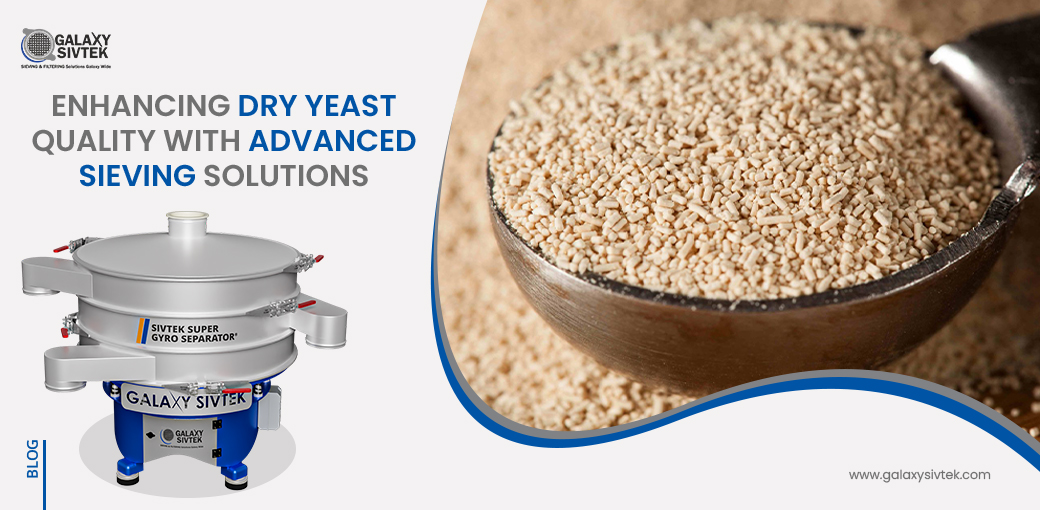
Dry Yeast Screening: How Precision Sieving Protects Product Quality and Performance
Introduction — where screening fits in the dry-yeast process
Dry yeast production follows a well-established industrial sequence: propagation (fermentation) → separation/concentration → washing → extrusion/granulation → gentle drying (typically fluidized-bed) → cooling → post-drying screening/sieving → packaging.
Although spray or fluidized-bed drying transforms yeast cream into shelf-stable granules, the output is rarely perfectly uniform. For this reason, dry yeast screening conducted immediately after cooling and before packaging is an essential quality assurance step. Proper sieving is critical in achieving the target granule size. It also ensures consistent flowability as well as predictable rehydration and fermentation performance to the end user.
The sieving & screening process for dry yeast (practical overview)
Post-dryer, cooled granules travel by conveyor to an enclosed sieving station. The goals are simple and critical:
- Scalp oversized lumps and fused particles created during drying or handling.
- Remove foreign matter or non-conforming pieces.
- Deliver a narrow particle size distribution to meet product spec (e.g., Active Dry Yeast: ~0.5–2.5 mm; Instant yeast: ~0.15–0.8 mm).
A modern installation typically uses a hygienic circular vibro separator (GS) as the primary final cut. Depending on product sensitivity and throughput, a conditioning stage (Roto Sifter) or a gentler Tumbler screen may be added upstream.
Key challenges in dry-yeast screening
Dry yeast is a food product with live biological activity and distinct handling challenges:
- Fragility and viability risk — high mechanical impact can damage the cells and slow down fermentation activity.
- Soft agglomerates — partially fused granules created during drying can pass through or blind mesh screens.
- Dust control and hygiene — yeast dust goes airborne and will require a completely enclosed easy-clean equipment with proper attention to clearly defined GMP & food safety criteria.
- Achieving tight particle distribution — different applications require tight size windows that can be hard to achieve at scale.
- Throughput vs. quality trade-off — higher line speeds can increase oversize and fines if screening equipment isn’t matched to process needs.
Addressing these issues requires equipment selection tuned to product behavior and practical machine settings that prioritize gentle action without sacrificing separation accuracy.
Sivtek screening solutions
Based on decades of powder-processing practice, the following Sivtek machines give the best balance of hygiene, throughput and gentle action for dry yeast:
1. Sivtek Vibro Separator (GS) — the primary recommendation
- Role: Final post-dryer screening and grading.
- Why: Gentle circular vibration provides accurate scalping of oversize lumps and maintains granule integrity. GS units come with sanitary finishes, quick-release clamps for easy cleaning, and adjustable motion settings to ensure product viability.
- Best for: Most ADY and most instant yeast lines where a steady throughput and uniform particle sizing are a priority
2. Super Gyro Separator (SGS) — for high capacity and fine grading
- Role: Final post-dryer screening and grading.
- Why: Gentle circular vibration provides accurate scalping of oversize lumps and maintains granule integrity. GS units come with sanitary finishes, quick-release clamps for easy cleaning, and adjustable motion settings to ensure product viability.
- Best for: Most ADY and most instant yeast lines where a steady throughput and uniform particle sizing are a priority
3. Roto Sifter (rotary/centrifugal sifter) — conditioning and de-agglomeration
- Role: Final post-dryer screening and grading.
- Why: Gentle circular vibration provides accurate scalping of oversize lumps and maintains granule integrity. GS units come with sanitary finishes, quick-release clamps for easy cleaning, and adjustable motion settings to ensure product viability.
- Best for: Most ADY and most instant yeast lines where a steady throughput and uniform particle sizing are a priority
4. Tumbler Screen — low-shear, gentle solution where viability is key
- Role: Final post-dryer screening and grading.
- Why: Gentle circular vibration provides accurate scalping of oversize lumps and maintains granule integrity. GS units come with sanitary finishes, quick-release clamps for easy cleaning, and adjustable motion settings to ensure product viability.
- Best for: Most ADY and most instant yeast lines where a steady throughput and uniform particle sizing are a priority
Why choose Galaxy Sivtek for dry-yeast screening
Galaxy Sivtek combines practical plant experience with food-grade engineering:
- Application expertise: Machines and installation know-how from bakeries, yeast plants, and powder processing industries.
- Sanitary design: 316/304 stainless contact parts, smooth finishes and fully enclosed systems for dust control and easy sanitation.
- Secured performance: a range of GS, SGS and Roto options that let you balance throughput, cut precision and product gentleness.
- Commissioning support: process trials, recommending mesh selection, KPI set-up (oversize %, viability retention, rehydration time) to verify performance.
Conclusion
Screening is the last line of defense between dryer output and the packed product. Well-specified sieving keeps granules consistent, preserves yeast activity, improves packer performance and prevents costly rework or customer complaints. For most dry-yeast operations, a hygienic Sivtek Vibro Separator (GS) is the ideal starting point — with Roto Sifters, Tumbler screens or SGS added only where product nuance or capacity requires them.
Ready to improve your dry yeast screening process? Our experts at Galaxy Sivtek will guide you with the right sieving solutions for your production needs.